
Induction Form
Bajwa Harvesting Pty Ltd
INDUCTION BOOKLET
Welcome to Bajwa Harvesting Pty Ltd. We hope that you find your work here informative and rewarding. The health and safety of all the people who work on this farm which we work on is the most important responsibility that we all share.
It is important that you understand our Work Health and Safety responsibilities. We want you to also understand the commitment that we as owners/ supervisors of this farm have made to ensure your health and safety of all others who may enter our farm. We are responsible for while you are working on the farm. Perform various duties and responsibilities diligently, assigned to you by the employer.
- Take proper care of the health and safety of yourself and others.
- Comply with all lawful orders and instructions given by the Employer.
- Report all unsafe condition, equipment, incidents and any injuries to
Reporting for work: –It is important that you let your supervisor, or their delegate know when you arrive and before you depart the farm. This so in the event of an emergency we can ensure that everyone who is currently on-site has-been safely evacuated.
WORK AND CLOTHES: –You’re expected to come to work dressed in suitable clothes which do not pose a safety risk. These includes: –
- Suitable work boot with non-slip soles for work on the farm or packing shed, Jeans, trouser, overalls or sensible work shorts.
- Long sleeved shirts buttoned at the wrist or rolled up so that no loose ends can be caught in machinery or on protruding materials.
- A wide brimmed hat for the outdoor work.
- You are expected to wash your clothes after each work day.
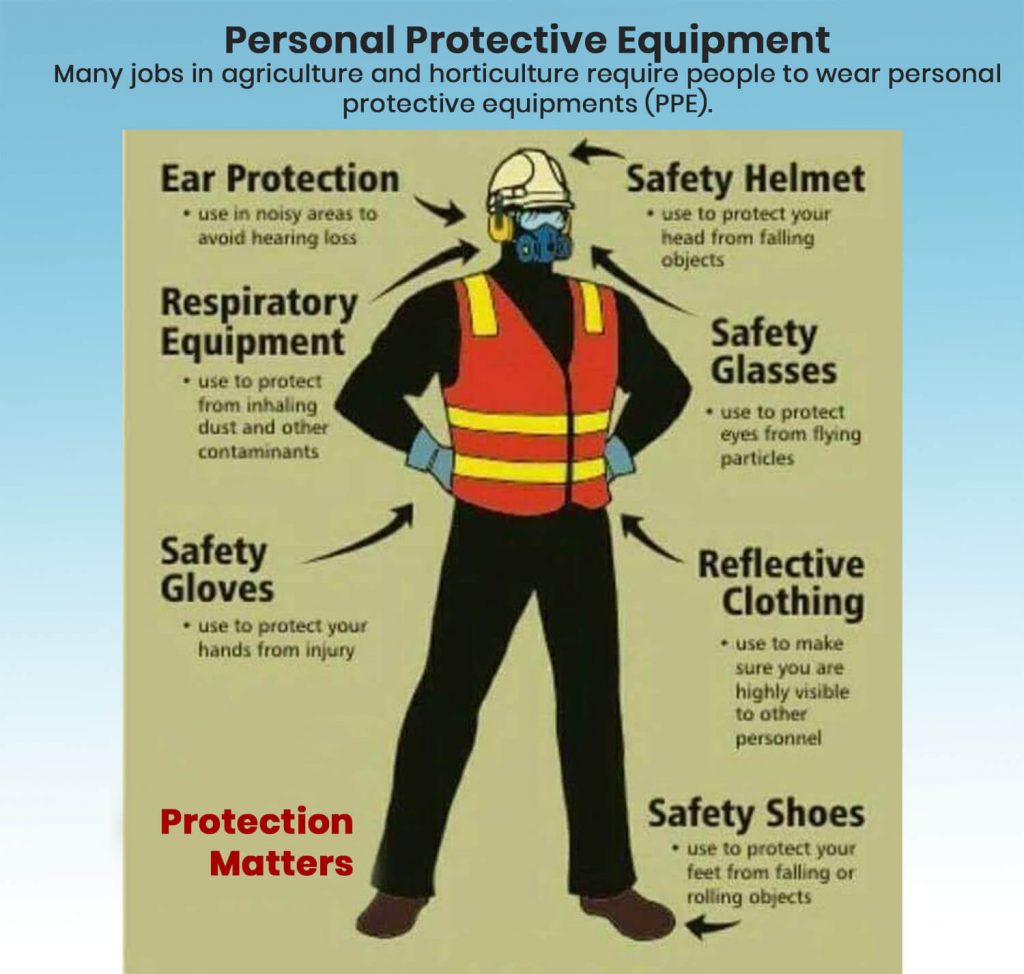
PERSONAL PROTECTIVE EQUIPMENT (PPE)
Protective clothing and equipment are provided for your protection for some work. You must use these as instructed. Clean them properly after use and keep them in good order.
You must let your supervisor know if protective equipment is damaged, not available, or if you are having difficulty using the equipment provided. Protective equipment includes wearing or using:
- Ear muffs or plugs where noise is a problem
- A helmet for head protection when riding motorbikes and quads.
- Protective gloves, respirator and overalls when handling pesticides.
- A facemask or respirator when dust is a problem and you suffer from asthma or other respiratory condition.
- Eye protection where insects and twigs may cause eye injury.
- Sunscreen when you are working outdoors in direct sunlight.
BATHROOMS: – There are portable bathroom located near the picking areas for convenience. Refer to Farmer Induction Handbook as well for Bathroom location.
SMOKING AREAS: -The farm has assigned smoking areas near the shed and picking areas. If you do smoke, put your cigarette butts in the located bins. Before returning to work, you must wash your hands.
FOOD AND WATER: – It is important to make sure that you have plenty of clean and drinking water during the workday, especially in hot weather.
TRAINING AND INDUCTION: Training and induction are conducted in order to show you to how to perform a task safely in accordance with the industries standard operating procedures (SOPS) and in accordance with company’s policies and procedures. During your time at farm you will take part in training in the various task, processes and procedure. This training may be
- Formal: – Formal learning refers to a type of learning program in which the goals and objectives are defined by the training department, instructional designer, and/or instructor.
- Informal: -Informal learning is a pervasive ongoing phenomenon of learning via participation or learning via knowledge creation, in contrast with the traditional view of teacher-centred learning via knowledge acquisition. The term is often conflated, however, with non-formal learning, and self-directed learning.
- Internal: – Internal training methods involve the use of company’s own resources and expertise to develop and deliver the specific type of training. It is cost-effective, informal, and brings improvement in the existing training methods and employee communication.
Proximity, threat and event reporting guidelines: The objective is to minimise the risk of incidents and injuries occurring at the workplace by identifying hazards and reporting them in the affected area. We all have a responsibility to identify hazards and the company has processes for reporting and managing them.
The purpose of incident reporting is to ensure that all injuries, hazards are addressed, investigated and recorded in a safe and timely manner. This is, so company can act to prevent a reoccurrence, or in the case of hazards, the occurrence of our injury
| It is your responsibility to report all unsafe work practices, equipment, incidents or Injuries as soon as practical after the incidents. |
WHEN to Report
You must report if one of the following occur:
Injury: – Any event which you require first aid or other medical treatment for injury or illness.
Near miss: – Any event which has the potential to cause injury, illness property damage, fire or spill in the workplace.
Hazards: – Something in the workplace that has the potential to cause harm to a person.
Fire: – Any event where smoke or fire is present that requires action by employees or local/community fire bridges.
Spill: – Anywhere that material is spilled (inside or outside the facility) which require special clean up action by employees, local community hazard material team, on fire brigade.
Events to be recorded are: –
The death of a person whether an employee, contractor or member of the public.
A serious injury or illness.
A dangerous incident that exposes any person to a serious risk, even if no one is injured.
First Aid:
First Aid Kit is always available in Employer Motor vehicle.
First Aid Qualified-Farm Manager Sukhvinder Singh: 0435 648 031
The injured person or best witness must inform the area supervisor of the incident as soon as possible. Complete Incident Report Form with supervisor within 24 hours, for all injuries and near miss incidents. Use this same form to report any identified hazards that require corrective action.
The incident report for an accident or injury such as a fall should include the following information: Circumstances of the incident. Date, time, and location of fall, and during which shift and on what unit the fall occurred. Witnesses’, staff members’, and resident’s accounts of the incident.
LIST OF SOPS MENTIONED BELOW SHOULD BE FOLLOWED TO ACHIEVE ZERO HARM AND SAFE WORK POLICY
Lifting and Manual handlings
Whenever you need to lift an object it is important that you do so correctly. Lifting and carrying objects incorrectly can result in injuries.
Before you pick up the object: Check the weight (if it is too heavy to consider getting someone to help you or using a pallet jack or forklift to assist to lift it.)
Clear a path (make you sure nothing in the way on the path you will be carrying the object.)
WHILE LIFTING
- Stress your stomach muscles
- Bend your knees.
- Use your legs muscles to assist to you to lifting the object.
- Keep your head up and your back natural upright position.
YOU MUST DO
NEVER bend your back to lift an object.
NEVER lift or carry your object that is too heavy for you.
NEVER twist while carrying an object.
KEEPING THE WORKPLACE CLEAN AND CLEAR
While you are working it is essential that you set up and maintain your work area to keep it clear and slip hazards. Trip and hazard are thing that you and others can easy trip over or slip over on, such as fruit, labels, boxes and pallets.
CLEANLINESS REQUIREMENT
All workers must: –
- Follow personal hygiene instruction
- Follow all clearing instructions
- Keep your personal food in designated areas
- Tell your supervisor if an allergen is identified and likely to contaminate produce
PERSONAL HYGIENE
Good personal hygiene will help to reduce the risk of illness due to infection or contamination with hazardous chemicals that you may be exposed.
- Always wash your hands with soap and water and dry them in a single use paper towel before handling produce after
- Using the toilet, Eating or Smoking
- Handling animals waste food or rubbish
- Any other time when there is risk of contaminating produce Use the hand sanitizers direct to
- Cover all the wound and sores with clean, waterproof dressing
- Do not smoke, eat or spilt in growing, packing and storage areas
- Report gastric illness or communicable diseases (e.g. influenza, hepatitis) to supervisor
- Plastic water bottles, mobile phone required as part of the job are allowed
- Regularly clean reusable gloves (if worn) so as not to contaminate produce, Keep up to date with your tetanus vaccination.
CARS AND OTHER VEHICLES: Only person who have been given permission from the farm manager of their delegate to drive a vehicle on the farm manager or their delegate to drive a vehicle on farm is permitted to do so.
FORKLIFTS (including tractor)
Licensed to operate: – Only person who have a valid High-Risk Work Licence and have been authorised by the Employer to operate a Forklift or Tractor forklift can drive Forklift or Tractor.
Checks: – Prior to operating a Forklift a visual inspection and pre start check list should be sign (check list from the farmer) The inspection should be conducted to ensure they are in safe working condition and in accordance with the manufacture’s guidelines. Any faulty equipment must be immediately informed to the farm manager.
Operation: – Forklift can cause risk of to the safety of the operator and other in the workplace. In a particular there is risk to operators and by standards due to Forklift roll over, run over and unsafe driving practices. It is essential that forklift is operated in safe manner all the times.
All forklift operators must: – Ensure they are familiar with the operator’s manual and Forklift operation policy, wear a seatbelt, obey speed limits, give way to pedestrian Maintain a safe distance from other vehicles and structures, considering the conditions they are driving in
The following is strictly prohibited while conducting a Forklift
- The use of headphones and mobile phone
Emergency Management
IN CASE OF EMERGENCY
FARM NAME: Jendra Farms Pty Ltd
FARM ADDRESS: 2329 Foresthill Fernvale Rd, Mt Tarampa QLD 4311
FARM PHONE NO: 0400 981 292 (Jendra Farm Pty Ltd)
FARM MANAGER: Mark Jendra
EMERGENCY PH NO:
- POLICE, AMBULANCE AND FIRE: 000
- POISONS INFORMATION CENTRE: 13 11 26
- LAIDLEY HOSPITAL: 07 5466 8100
- GATTON HOSPITAL: 07 5468 4188
- The person responsible for emergency coordination is the Supervisor or Employer
- Workers should not try to fight fires, deal with the spillage of hazardous substances, undertake rescues or do anything to control an emergency unless you or they are confident to do so and have been trained in the correct procedures
- Contact first Aid qualified Farm Manager Sukhvinder Singh: 0435 648 031
- First Aid Kits are always available in employer motor vehicles.
- If an emergency evacuation is required calmly make your way to the nearest exit, listening to any instructions provided by your Employer or Supervisor.
- Please return to your own vehicle and find out how you would make your way to this point from any position within the farm. Consider alternatives in case your usual path is blocked as a result of the emergency.
ALL EMPLOYEES ARE RESPONSIBLE FOR:
Taking reasonable care for their own health and safety and for that of others around them Follow all guidelines, safe work practices instructions and rules.
Report any unsafe conditions, equipment, incidents, injuries or near misses to management
BAJWA HARVESTING PTY LTD
EMPLOYEE ACCEPTANCE
